Bobchinsky–Dobchinsky duo
The Government InspectorThe Bobchinsky–Dobchinsky duo is a comic partnership whose gossip, shared curiosity, and competing accounts help transform a chance encounter into the town’s governing crisis. The two country squires are alike enough to be described as strikingly similar, yet distinct in temperament: Bobchinsky is freer and livelier, while Dobchinsky is slightly taller and more subdued. Their report of a young lodger at the inn gives the town a supposed inspector to fear, and the play’s ending returns to the pair as the alleged source of that mistake.
Identity and Temperament
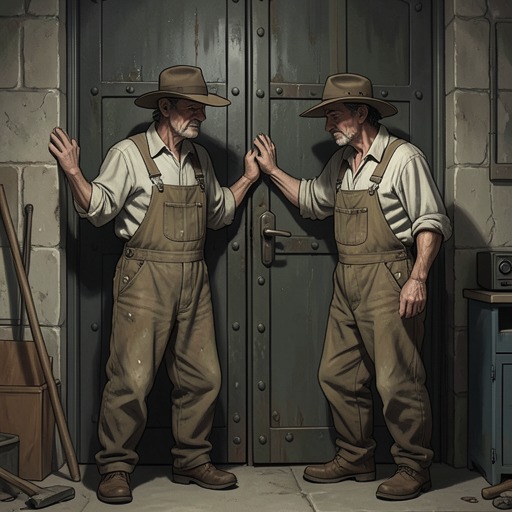
Piotr Ivanovich Bobchinsky and Piotr Ivanovich Dobchinsky are both identified as country squires. Their physical resemblance is conspicuous: they are short, small-paunched men who look remarkably like each other. Their speech and movement intensify the impression of a pair. They talk rapidly and emphasize their words with their hands, faces, and whole bodies; both are exceedingly inquisitive.
The resemblance does not erase their differences. Piotr Ivanovich Dobchinsky is a little taller and more restrained, whereas Piotr Ivanovich Bobchinsky is easier, livelier, and more expansive. The contrast becomes especially visible when they tell their story. Bobchinsky repeatedly takes control of the narration, urges Dobchinsky not to interrupt, and insists that he can tell the events properly. Their partnership is therefore not a perfectly balanced exchange: they share discoveries, but compete over who gets to present them.
The Errand and the Inn
Their consequential discovery grows out of an ordinary sequence of visits and errands. After leaving the Governor, Piotr Ivanovich Bobchinsky says that he went looking for Korobkin; finding him away, he tried Rastakovsky and then went to the postmaster to pass on the news of the Governor’s letter. He met Piotr Ivanovich Dobchinsky on the way. Their next business was to obtain a small keg of French brandy from Pachechuyev’s. On the way there, Dobchinsky suggested stopping at the inn because he had eaten nothing since morning and had heard that fresh salmon had arrived.
Inside, they noticed a young man walking about the room. Bobchinsky recalls his good appearance, civilian clothes, and unusual air, and says that the encounter seemed to him more than ordinary. Dobchinsky questioned Vlas, the innkeeper, quietly. Vlas identified the lodger as Ivan Aleksandrovich Khlestakov, an official traveling from Saint Petersburg toward the government of Saratov. He had remained at the inn into his second week, had not gone out, and was taking things on account without paying. These details were observations about a stranded traveler; the squires treated them as clues to a hidden official purpose.
From Suspicion to Misidentification
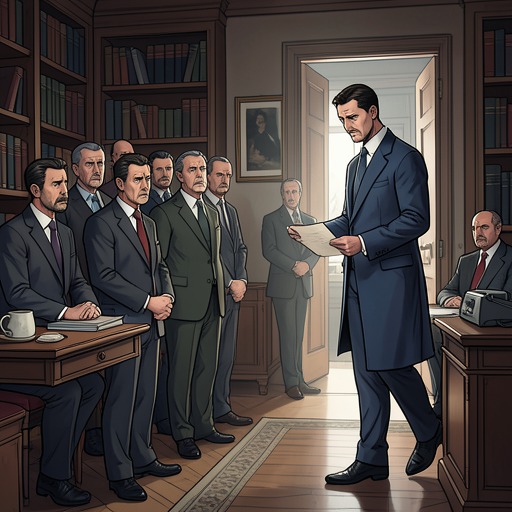
The inn report reaches the Governor at a moment when he has already been warned that an inspector from Saint Petersburg is coming incognito, with secret instructions. The news of a lodger who is an official, stays inside, and does not settle his bills appears to fit that warning. Bobchinsky and Dobchinsky identify him as the expected inspector, and the Governor reacts with alarm, insisting that it cannot be the man even as they confirm their conclusion.
The force of the episode lies in the gap between what the pair know and what they infer. They have found a real traveler and gathered concrete facts about his stay, but those facts do not establish that he is an inspector. Their rapid, excited report supplies a persuasive pattern for the Governor’s fears: the official has come from the capital, behaves strangely, and is lingering in the town. The partners do not need to invent the lodger’s circumstances; their mistake comes from fitting those circumstances to the warning already circulating among the officials. Their shared curiosity thus becomes an accidental engine of the plot.
A Partnership in Performance
Their scene is built not only around the news but around the difficulty of delivering it. Bobchinsky attempts to tell the story from the beginning, moving through his visits, the brandy errand, and the stop at the inn, while Dobchinsky repeatedly interjects. Bobchinsky rebukes him for interrupting and for being unable to tell the story, then resumes his own version. The exchange dramatizes both their familiarity and their rivalry over the account: each is involved in the discovery, but Bobchinsky claims the role of principal storyteller.
That manner also shapes how the news arrives. The pair’s haste, gestures, and interruptions make the report feel urgent, while its winding route and digressions reveal how an interpretation is assembled from scattered details. Bobchinsky even pauses to describe Vlas’s family before returning to the lodger’s identity and behavior. The report is comic in its abundance, but its effect on the listeners is immediate: the Governor treats the pair’s conclusion as confirmation of the feared inspection and begins preparing the town for scrutiny.
Blame and Narrative Significance
When the Postmaster announces that the man they took for an inspector was not an inspector, the mistaken identification becomes public knowledge. Later, the Governor asks who first said it and points to the two squires as the responsible pair. Bobchinsky denies that he was first and says that he had not even thought of it. The available exchange establishes the accusation and his denial, not a settled account of which partner originated the idea.
The ending makes their shared function newly visible. Earlier, their close resemblance and joint arrival can make them seem like a single comic unit; at the moment of blame, the town tries to locate the mistake in its first speaker. Bobchinsky’s denial resists that simple assignment even as the Governor points to both men. Their partnership has carried the rumor from an inn-room observation into an official crisis, but the play leaves the exact first spark contested. They are not merely witnesses to the misidentification: their hurried interpretation gives it a voice, a route through the town, and consequences for everyone who believes it.